
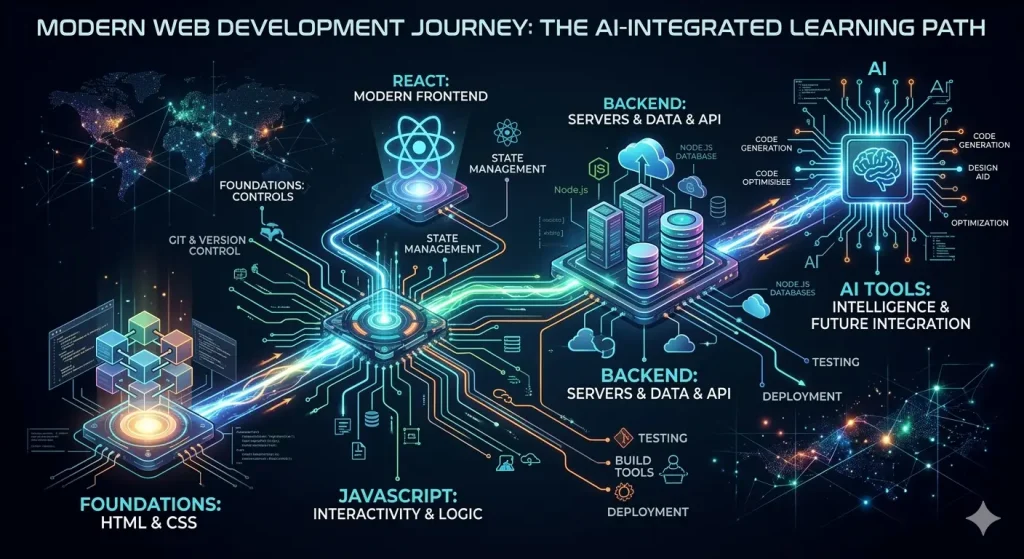
Learning web development in 2026 is one of the most valuable skills you can acquire. Nearly every modern business depends on websites and web applications to reach customers, manage operations, and deliver digital services. From simple blogs to complex platforms like online marketplaces, web development powers a huge portion of the internet.
However, beginners often feel confused because there are so many programming languages, frameworks, and tools available. Many people start learning randomly and quickly become overwhelmed.
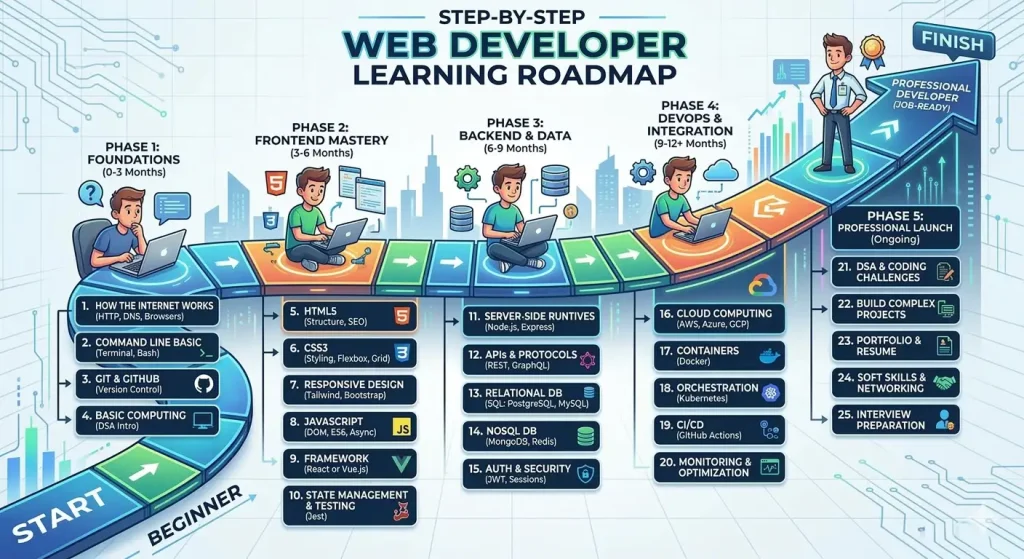
This web development roadmap for beginners explains the exact learning path you should follow in 2026. Instead of jumping between technologies, this guide shows a clear step-by-step structure. If you follow this roadmap consistently and build real projects along the way, you can develop strong skills and prepare yourself for professional opportunities in web development.
Whether you want to become a freelancer, create your own online products, or pursue a full-time developer career, this roadmap will help you understand what to learn and when to learn it.
What is Web Development?
Web development is the process of creating websites and web applications that run inside internet browsers. Developers write code using different programming languages to build digital experiences that users can interact with.
Modern web development usually includes three main areas:
- Frontend Development – The visual part of a website that users see and interact with.
- Backend Development – Server-side systems that process data and manage logic.
- Databases – Systems used to store and organize information.
For example, when you log into a website, the frontend displays the interface, the backend processes your login request, and the database stores your account information.
Understanding how these three parts work together is a core concept in the web development roadmap for beginners.
Why Learn Web Development in 2026?
The demand for web developers continues to grow globally. Businesses need websites, startups need web applications, and digital products are constantly evolving.
There are several reasons why learning web development is a smart decision today:
- High global demand for developers
- Remote work opportunities
- Freelancing possibilities
- Ability to build your own products
- Constant innovation and new technologies
Another advantage is that web development has a relatively low barrier to entry. Anyone with internet access and dedication can start learning.
Step 1: Learn HTML – The Foundation of the Web
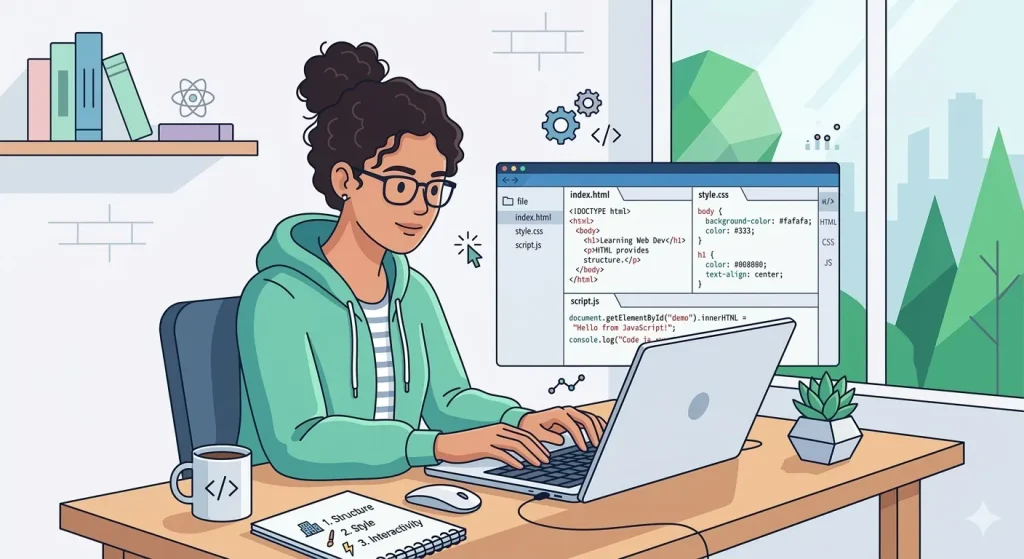
HTML (HyperText Markup Language) is the basic building block of every website. It defines the structure of web pages and tells browsers how to display content.
HTML allows developers to add elements such as:
- Headings
- Paragraphs
- Images
- Videos
- Links
- Forms
Beginners should learn semantic HTML elements like header, section, article, and footer. These tags help organize content and improve accessibility for users and search engines.
Although HTML is relatively easy to learn, mastering it properly is extremely important because every website relies on it.
Step 2: Learn CSS – Styling and Layout
After learning HTML, the next step in the web development roadmap for beginners is CSS (Cascading Style Sheets). CSS controls how websites look and feel.
Without CSS, websites would appear plain and unstructured. CSS allows developers to design beautiful user interfaces by controlling colors, fonts, spacing, layouts, and animations.
Important CSS concepts include:
- The CSS Box Model
- Flexbox layout system
- CSS Grid for advanced layouts
- Responsive design
- Media queries
- Animations and transitions
Responsive design is especially important because many users browse the internet using smartphones. Websites must adapt to different screen sizes to provide a good user experience.
Step 3: Learn JavaScript – The Logic of Web Applications
JavaScript is the programming language that makes websites interactive. It allows developers to create dynamic features that respond to user actions.
Examples of JavaScript functionality include:
- Interactive forms
- Dynamic content updates
- Image sliders
- Real-time notifications
- API communication
Beginners should focus on learning the following JavaScript fundamentals:
- Variables and data types
- Functions
- Arrays and objects
- DOM manipulation
- Event listeners
- Asynchronous programming
JavaScript is one of the most important technologies in the web development roadmap for beginners because modern websites rely heavily on it.
Step 4: Learn Git and GitHub
Professional developers use version control systems to track changes in their code and collaborate with other developers.
Git is the most widely used version control system in the software industry.
Important Git concepts include:
- Repositories
- Commits
- Branches
- Merging
- Pull requests
GitHub is a platform that hosts Git repositories and allows developers to collaborate on projects. Learning Git and GitHub early will help you manage your code more professionally.
Step 5: Learn Frontend Frameworks
After mastering JavaScript fundamentals, the next step in the web development roadmap for beginners is learning a frontend framework.
Frameworks help developers build complex user interfaces more efficiently by organizing code into reusable components.
Some popular frontend frameworks include:
- React
- Vue
- Angular
React is currently one of the most widely used frameworks in modern web development. It allows developers to build dynamic applications using reusable components and efficient rendering techniques.
Step 6: Learn Backend Development
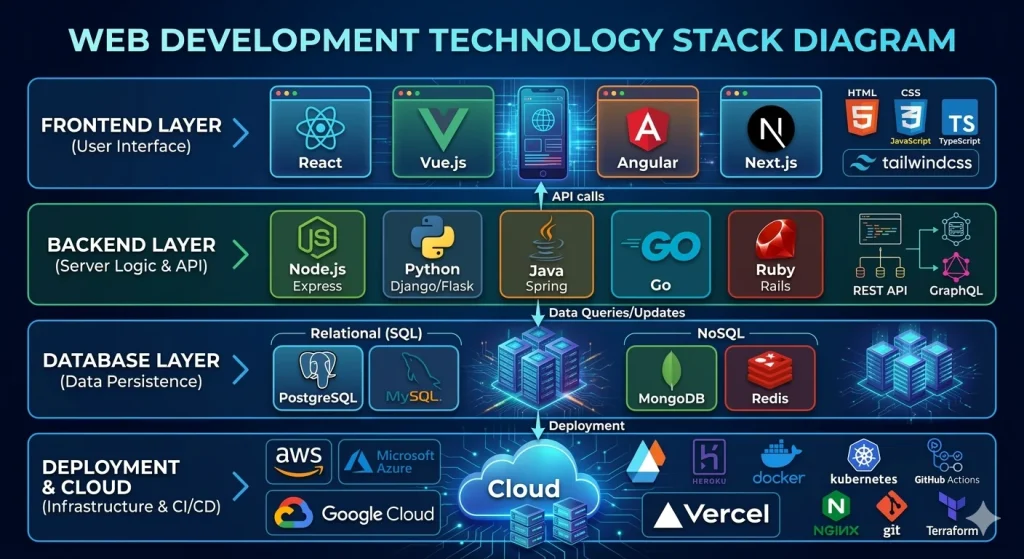
Frontend development focuses on the visual part of websites, but backend development handles server logic and data processing.
Backend systems perform tasks such as:
- User authentication
- Data storage
- API creation
- Payment processing
- Business logic execution
Popular backend technologies include:
- Node.js with Express
- Python with FastAPI
- PHP with Laravel
Learning backend development allows you to build full-stack applications instead of only frontend interfaces.
Step 7: Learn Databases
Most web applications need to store data such as user profiles, products, posts, or comments. Databases are used to organize and retrieve this information efficiently.
Common databases include:
- MongoDB
- PostgreSQL
- MySQL
Developers should understand how to create tables or collections, store data, and retrieve information using queries.
Step 8: Learn Deployment and Hosting
After building a website, the next step is making it accessible on the internet. This process is called deployment.
Popular hosting platforms include:
- Vercel
- Netlify
- Cloudflare Pages
- DigitalOcean
Learning deployment helps developers understand how real applications run in production environments.
Step 9: Use AI Tools for Development

Artificial intelligence is transforming how developers write code. AI tools can help generate code snippets, debug errors, explain concepts, and automate repetitive tasks.
If you want to explore AI tools further, you can read:
Popular AI tools developers use include:
- GitHub Copilot
- Cursor AI
- ChatGPT
- Claude
These tools can improve productivity and help developers learn faster.
Step 10: Build Real Projects
Projects are the most important part of the web development roadmap for beginners. Building projects helps you apply your knowledge and develop real problem-solving skills.
Some beginner project ideas include:
- Personal portfolio website
- Weather application
- Task manager app
- Simple blog platform
- Basic e-commerce website
As your skills improve, try building more complex projects with authentication, databases, and APIs.
How Long Does It Take to Become a Web Developer?
The time required depends on your dedication and practice schedule. Many beginners can develop strong skills within 8–12 months of consistent learning.
A possible learning timeline might look like this:
- 3 months – Basic HTML, CSS, and JavaScript
- 6 months – Intermediate frontend development
- 9 months – Full-stack fundamentals
- 12 months – Job-ready skills and portfolio
The key to success is consistency. Regular practice and project building will help you improve steadily.
Best Free Resources for Learning Web Development
Several high-quality resources can help beginners learn web development effectively.
- FreeCodeCamp
- The Odin Project
- Scrimba
You can also explore the MDN Web Docs web development guides, which provide detailed documentation for modern web technologies.
Conclusion
The web development roadmap for beginners in 2026 focuses on mastering the fundamentals first and gradually learning advanced technologies.
By learning HTML, CSS, JavaScript, frontend frameworks, backend development, databases, and deployment, beginners can build powerful applications and prepare for professional developer roles.
The most important advice is to stay consistent and keep building projects. Over time, your experience will grow, your portfolio will expand, and your confidence as a developer will increase.